
Shun is the Japanese knife brand I’d point most American home cooks to first. The knives are made in Seki, Japan, by Kai, a company that has been making blades there since 1908. They’re very sharp out of the box, they look beautiful, and Shun sharpens them for free for the original owner, which no German brand I cover matches.
They’re also not for everyone. Shun’s VG-MAX steel is hard (around 61 HRC) and ground to a 16 degree edge, so it holds that sharpness for a long time but may chip when you lever it through a squash, cut through bone or hit a glass board. If you treat knives roughly, a German knife will forgive you; a Shun won’t.
So which line? Classic is the original, Premier adds a hammered finish, Sora is the value line, and Kanso drops the Damascus for a plain, low-fuss blade. My pick for most buyers is the Shun Classic 8″ Chef’s Knife. If you’d rather start with a set, the Premier 3-piece starter set is the best Japanese set I know of.
My Top 6 Shun Picks

The knife that made Shun famous in the US and still the one I’d buy first. It keeps a Western-style curve, so it rocks like the chef’s knife you’re used to, with a much finer edge.
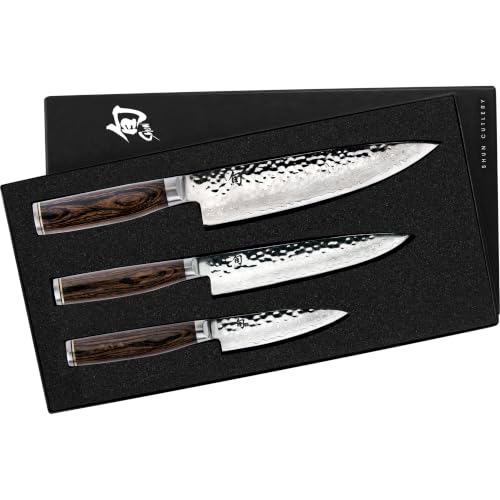
Chef’s, utility and paring knife with Premier’s hammered finish. Three knives you’ll really use, no block full of extras.
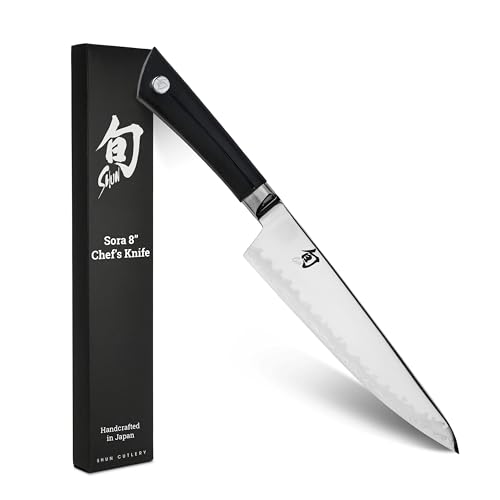
The cheapest way into a Shun chef’s knife: a VG10 cutting edge, a grippy polymer handle and the same free sharpening as the expensive lines.

No Damascus, no polish: a plain, tough-looking blade and a dense wood handle. For cooks who want a Shun that doesn’t need babying to look good.

A flat-edged vegetable knife that makes quick work of cabbage, onions and herbs. The Shun I’d add second for anyone who cooks a lot of vegetables.

For cooks who prefer a shorter, flatter blade to a chef’s knife. The hammered finish helps slices fall away.
What Shun Does Well
Sharp edges that last
Shun’s main lines use VG-MAX, Kai’s own version of the well-known VG10 steel, at around 61 HRC with a 16 degree edge on each side. That’s harder and finer than a typical German knife, so a Shun cuts tomatoes and onions cleanly and needs sharpening less often.
Free sharpening for life
Shun sharpens its knives for free for the original owner; you pay the postage. I mention it in almost every Shun recommendation because it solves the biggest worry with a hard Japanese knife: what happens when it gets dull or chipped.
Made in Seki, Japan
Every Shun is made in Seki, the Japanese city famous for blades. Kai, Shun’s parent company, has been making knives there for over a century, and the fit and finish show it.
Japanese edge, Western-friendly shapes
Many Shun chef’s knives keep a curved belly, so you can rock them like a German knife. That makes the switch from a Wüsthof or HENCKELS much easier than going straight to a flat gyuto.
What Shun Does Badly
Chipping is the main complaint
The complaint I see most from Shun owners is chipped edges and tips. Hard steel is less tough than soft steel, so prying, twisting, bones, frozen food and glass or stone boards will chip it. It’s a trade-off, not a defect, but it surprises people moving up from German knives.
Expensive across the board
Even Sora, the value line, costs much more than the budget chef’s knives I usually recommend. You pay for the steel, the Damascus layers and the finish. If looks don’t matter, there are cheaper Japanese knives that cut just as well.
D-shaped Classic handles
The Classic line uses a D-shaped handle. Shun says it suits both hands, but the flat side is meant to sit against your fingers and some cooks, especially with smaller or larger hands, find it awkward. Premier’s rounder handle suits more people.
Whetstones, not pull-through sharpeners
A cheap pull-through gadget set up for German angles will grind the wrong bevel onto a Shun. Use a whetstone, Shun’s own sharpener, or the free service.
Shun Lines Compared
| Line | Steel | Blade finish | Handle | Best for |
|---|---|---|---|---|
| Classic | VG-MAX core, 68-layer Damascus | Damascus | Black pakkawood, D-shaped | Most careful cooks |
| Classic Blonde | Same as Classic | Damascus | Light pakkawood, D-shaped | Classic with a lighter look |
| Premier | VG-MAX core, 68-layer Damascus | Hammered (tsuchime) and Damascus | Walnut-tone pakkawood, contoured | Food release, rounder grip |
| Sora | VG10 san mai edge, 420J stainless upper | Polished, wave pattern | Textured polymer | Value, wet hands |
| Kanso | AUS10A high-carbon stainless | Plain, rustic finish | Tagayasan wood, full tang | Low fuss, simple looks |
1. Shun Classic 8″ Chef’s Knife: Best Overall
Who it’s for: a careful home cook stepping up from a German or budget chef’s knife.
According to Shun, Classic was the first authentic Japanese line it introduced to American kitchens, and this 8″ chef’s knife is the piece most people picture. The VG-MAX core is clad in 68 layers of Damascus steel, sharpened to 16 degrees, and set in a black pakkawood handle.
What I like most is that it doesn’t ask you to change how you cut. The blade keeps a gentle curve, so you can rock through herbs the way you would with a German knife, but the edge is much finer and stays sharp much longer. For most people, that’s the upgrade they’re looking for.
My reservations are the ones that apply to all Shuns. Don’t use it on bones or anything frozen, wash it by hand, and stick to wood or rubbery plastic cutting boards. Treated that way, it’s a knife for decades.
Key specs
- Blade: 8″ VG-MAX steel inside 68 Damascus layers
- Edge: 16 degrees, double bevel
- Handle: D-shaped black pakkawood
- Handcrafted in Japan; free sharpening and honing
Pros
- Very sharp, long-lasting edge
- Familiar Western rocking curve
- Free sharpening service
Cons
- Edge can chip with twisting or bone work
- D-shaped handle doesn’t suit every hand
My verdict: the Shun I’d buy first. Rough on knives? Get a German one instead.
2. Shun Premier 3 Piece Starter Set: Best Set
Who it’s for: someone building a Japanese kit from scratch, or a big gift.
I named this the best Japanese set overall in my Japanese knife sets guide, and the reasoning holds here. You get an 8″ chef’s knife, a 4″ paring knife and a 6.5″ utility knife: the three knives that do nearly everything, without a block of extras.
Premier’s look is its own. The blade has a hammered tsuchime finish, small dimples that cut drag and help potatoes and cucumbers fall away, plus a Damascus pattern near the spine. The contoured walnut-tone handle is rounder than the Classic’s D-shape, which I think suits more hands.
The steel is the same VG-MAX as the Classic, so it cuts no better. You’re choosing Premier for the finish and the handle. If you’re unsure which to choose, my Shun Premier vs Classic comparison goes deeper.
Key specs
- Knives: 8″ chef’s, 6.5″ utility, 4″ paring
- Steel: VG-MAX, clad in 68 Damascus layers
- Finish: hammered tsuchime
- Handles: contoured pakkawood; free sharpening and honing
Pros
- Only the knives you’ll use
- Hammered finish reduces sticking
- Rounder handle than Classic
Cons
- No block or storage included
- Same chipping risk as every Shun
My verdict: the best way to buy Shun as a set. Add a magnetic strip and you’re done.
3. Shun Sora 8″ Chef’s Knife: Best Value Line
Who it’s for: cooks who want a Shun edge and the free sharpening for less than a Classic.
Sora uses what Shun calls Composite Blade technology. Only the cutting edge is VG10, in a san mai construction (a hard core between softer layers), and it’s joined to a 420J stainless upper with a wave-shaped line. That way you get a real VG10 edge while the rest of the blade uses cheaper steel.
The blade is narrow, gyuto-style, which makes it nimble. The handle is a textured polymer blend, not wood, and I see that as a plus in a busy kitchen: it grips well wet and doesn’t mind water.
What you give up is weight and polish. It feels lighter and less substantial than a Classic, and the plastic handle won’t impress anyone.
Key specs
- Blade: 8″, VG10 san mai cutting edge, 420J stainless upper
- Edge: 16 degrees
- Handle: textured PP/TPE polymer, full tang
- Handcrafted in Japan; free sharpening and honing
Pros
- Cheapest Shun chef’s knife
- Grippy, water-friendly handle
- Same sharpening service
Cons
- Plastic handle looks plain
- Light, less substantial feel
My verdict: the smart entry into Shun. If you want the Damascus look, save up for the Classic.
4. Shun Kanso 8″ Chef’s Knife: Best Low-Fuss Shun
Who it’s for: cooks who like a simple, rugged-looking knife and don’t want a polished blade to worry about.
Kanso is named after a Zen design idea that means “simplicity”, and it shows. There’s no Damascus, just a plain AUS10A high-carbon stainless blade with vanadium, sharpened to 16 degrees. The rustic finish hides everyday scratches far better than the shiny Damascus lines.
The handle is tagayasan, a very dense wood nicknamed “iron sword wood”, on a full tang. It feels solid and balanced, and it’s a nice change from pakkawood.
AUS10A is a good steel, a little softer than VG-MAX in practice, so the edge won’t last quite as long, but it’s a bit more forgiving to sharpen. The plain look won’t appeal to everyone who buys Shun for its beauty.
Key specs
- Blade: 8″, AUS10A high-carbon stainless steel with vanadium
- Edge: 16 degrees; narrow, gyuto-style blade
- Handle: contoured tagayasan wood, full tang
- Handcrafted in Japan; free sharpening and honing
Pros
- Finish hides scratches
- Solid full tang wood handle
- Easier to sharpen than VG-MAX
Cons
- Plain looks for the brand
- Edge doesn’t last as long as Classic or Premier
My verdict: the Shun for cooks who care about use, not display. Pattern lovers should stick with the Classic.
5. Shun Classic 6.5″ Nakiri Knife: Best Vegetable Knife
Who it’s for: vegetable-heavy cooks who already own a chef’s knife.
A nakiri has a flat edge and a square tip, so the full length of the edge touches down together and cuts all the way through instead of leaving connected slices. This Classic version has the same VG-MAX core and D-shaped handle as my top pick, in a 6.5″ blade that’s big enough for a cabbage.
It’s the second Shun I’d buy, not the first. With no point, it can’t do detail work, and it’s not for meat on the bone. If you’d like a smaller, hammered version, the Premier 5.5″ is my top pick in my best nakiri knife guide.
Key specs
- Blade: 6.5″, VG-MAX with 68-layer Damascus cladding
- Edge: 16 degrees, flat
- Handle: D-shaped pakkawood
- Handcrafted in Japan; free sharpening and honing
Pros
- Clean, through cuts on vegetables
- Long enough for big produce
- Matches the Classic chef’s knife
Cons
- No tip for detail work
- Not for hard squash rinds or bone
My verdict: a joy for vegetable prep. As your only knife, choose the chef’s knife.
6. Shun Premier 7″ Santoku Knife: Best Santoku
Who it’s for: cooks who chop with an up-and-down motion and like a shorter blade.
The santoku is shorter and flatter than a chef’s knife, with a rounded tip that drops toward the edge. It suits push cutting and smaller boards, and many people with smaller hands find it easier to control than an 8″ chef’s knife.
Premier’s hammered finish does the most good on this shape, because santoku users slice a lot of potatoes, cucumbers and cheese that like to stick. The contoured pakkawood handle is the same comfortable shape as the starter set.
The flatter edge doesn’t rock well, so if you mince herbs by rocking, the Classic chef’s knife is the better fit. My santoku vs chef knife comparison explains which shape suits which cook.
Key specs
- Blade: 7″ VG-MAX, Damascus clad (68 layers)
- Finish: hammered tsuchime
- Edge: 16 degrees
- Handle: contoured pakkawood; free sharpening and honing
Pros
- Food releases well
- Easy to control
- Comfortable rounded handle
Cons
- Poor at rocking cuts
- Tip is less useful for fine work
My verdict: the Shun for santoku fans. Everyone else should start with the Classic chef’s knife.
Shun vs Other Brands
Shun vs Miyabi
Both are made in Seki. Miyabi’s top lines use harder SG2 steel and thinner edges; Shun offers free sharpening and more Western-friendly shapes. I compare them in Shun vs Miyabi.
Shun vs Wüsthof
This is Japanese vs German: Wüsthof is softer, thicker and more forgiving, Shun sharper and lighter but more fragile. My Shun vs Wüsthof comparison helps you pick by how you cook.
Shun vs Global
Global’s one-piece steel knives are light and sharp but can feel slippery. Shun’s wood and pakkawood handles are warmer and its Damascus lines look fancier; both need careful use and a whetstone.
FAQ
Are Shun knives worth it?
Yes, if you’ll use them carefully. You get a very sharp, long-lasting edge, beautiful finish and free lifetime sharpening. If you’re rough on knives, the money is better spent on a German knife. My short answer is in are Shun knives good?
What is the best Shun knife line?
Classic for most people. Premier if you want a hammered finish and a rounder handle, Sora for the lowest price, and Kanso for a plain, low-maintenance look.
What is the Rockwell hardness of Shun knives?
The VG-MAX lines (Classic and Premier) are around 61 HRC. That’s harder than German knives, which usually sit around 56 to 58, so Shuns hold an edge longer but chip more easily.
Do Shun knives chip easily?
They can if misused. Twisting the blade, cutting bone or frozen food, and glass or stone cutting boards are the usual causes. Small chips can be sharpened out, and Shun’s free service is the easy way to get that done.
Where are Shun knives made?
In Seki, Japan, by Kai, Shun’s parent company.
Can Shun knives go in the dishwasher?
No. Hand wash and dry them straight away. The dishwasher can chip the thin edges and damage the handles.
Final Verdict
Shun makes some of the best Japanese knives you can buy in the US, backed by a free sharpening service that takes the worry out of owning hard steel. The Shun Classic 8″ Chef’s Knife is my pick for most buyers. The Premier 3-piece starter set is the best way to buy Shun as a set, and the Sora 8″ is the budget way in.
Weighing Shun against other Japanese makers? My best Japanese knife sets guide puts them side by side.

Gary Portman founded knivesadvice.com in 2019. He learned to cook in his family’s kitchen as a kid and has used kitchen, pocket and outdoor knives ever since, from paring and fillet knives to survival blades he carries camping and hiking. He writes the site’s buying guides, brand reviews and sharpening how-tos to help readers find the right knife for the job. More about Gary.