
Buy the Victorinox Fibrox Pro 8″. It’s light, sharp and grippy, it’s the knife a lot of professional cooks learned on, and it’s cheap enough that you’ll use it hard instead of babying it. Spending more on a chef’s knife mainly buys nicer handles, fancier steel and prettier finishes, not better everyday cutting.
If you prefer the weight and bolster of a forged German knife, the HENCKELS Classic is my alternative. If you want a thinner Japanese edge, go for the MAC Chef Series gyuto.
My Top 7 Chef Knives Under $100

It looks like a restaurant supply knife because that’s what it is, and that’s its strength. The thin, light blade cuts cleanly, the textured handle stays put with wet or oily hands, and it’s cheap enough that you won’t be afraid to use it hard. I’d pick it over knives that cost three times as much.

For cooks who want a forged blade with a bolster but don’t want to spend much, this is my favorite. Mercer equips a lot of culinary students, and the Genesis has the solid, balanced feel of a pricier German knife with a grippy handle that’s comfortable for long prep sessions.

If you like a knife with some heft, the Henckels Classic is the one I’d suggest. It’s a forged, full tang German-style knife with a traditional riveted handle, and that extra weight helps when you’re breaking down squash, chopping nuts or cutting through chicken joints.

MAC’s 2mm blade is noticeably thinner than the German knives on this list, and that’s why I like it. It glides through onions, carrots and herbs with less force and leaves cleaner cuts. It’s made in Japan, and it’s the closest thing to a high-end Japanese knife you’ll find in this budget.

A sensible first step into Japanese knives. The hammered finish helps food fall away, the edge is ground at 16 degrees, and the full tang handle feels sturdy. The part I value most for beginners is Kai’s free sharpening and honing service.
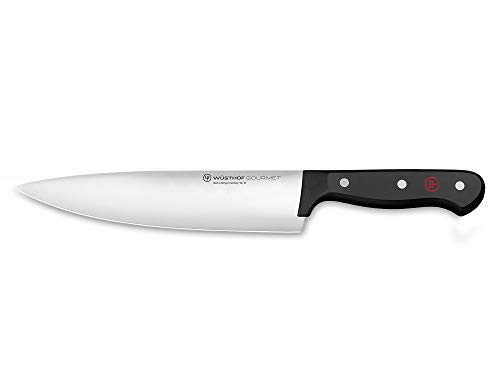
Want the WÜSTHOF name without paying Classic prices? The Gourmet line is laser cut instead of forged, which makes it lighter, but it’s still made in Solingen and backed by a lifetime warranty. I’d pick it for people who prefer a lighter German knife.

The Gladiator is a gift that looks expensive the moment the box opens. Under the presentation is a solid forged knife with a G10 handle and a sturdy feel. I’d buy it for a birthday or a housewarming rather than for myself, and I’m fine saying so.
Chef Knives Under $100 Compared
| Knife | Style | Blade | Construction | Handle | Best for |
|---|---|---|---|---|---|
| Victorinox Fibrox Pro | Western | about 8″ | Stamped, light | Textured TPE | Most home cooks |
| Mercer Genesis | Western | 8″ | Forged, bolster | Non-slip synthetic | Forged feel on a tight budget |
| HENCKELS Classic | Western | 8″ | Forged, full tang | Riveted synthetic | Heavy chopping |
| MAC Chef Series | Japanese gyuto | 8.5″ | Thin 2mm blade | Pakkawood | Precise, light cutting |
| Kai PRO | Japanese-style | 8″ | Full tang, hammered finish | Riveted POM | First Japanese knife |
| WÜSTHOF Gourmet | Western | 8″ | Laser cut, stamped | Polypropylene | Light German knife |
| Dalstrong Gladiator | Western | 8″ | Forged, full tang | Riveted G10 | Gifts |
1. Victorinox Fibrox Pro Chef’s Knife (8 Inch): Best Overall
Who it’s for: home cooks of every level who want a sharp, comfortable knife and care more about results than looks.
The Fibrox Pro has been a fixture in commercial kitchens and cooking schools for a long time, and the reason is simple: it does the core job very well for very little money. The blade is stamped from a sheet of stainless steel rather than forged, so it’s thin and light. That lightness is a feature. It makes long prep sessions less tiring, and a thin blade cuts through dense vegetables without the wedging you get from thicker knives.
The handle is what I’d point out to anyone who has had a knife slip. It’s made from a textured elastomer that stays grippy when your hands are wet, oily or covered in flour, which makes it one of the safest handles at any price. Victorinox also gives it a lifetime warranty against defects.
My reservations are about character, not performance. It doesn’t look like much on a magnetic strip, it doesn’t have the satisfying weight of a forged knife, and some people find the plastic handle feels cheap. The listing says dishwasher safe; I’d still wash it by hand, because a dishwasher dulls any edge faster. I covered this knife in more depth in my Victorinox Fibrox Pro chef knife review.
Key specs
- Blade: 7.9 inch tapered stainless steel, stamped
- Handle: thermoplastic elastomer (TPE), non-slip
- Made in Switzerland
- Lifetime warranty against defects
Pros
- Light, thin blade cuts very cleanly
- One of the grippiest handles you can buy
- Low price for professional quality
Cons
- Plain, utilitarian looks
- Too light for people who like a heavy knife
My verdict: if you just want a great chef’s knife and don’t care about prestige, stop here. Look further down only if you want heft or a Japanese edge.
2. Mercer Culinary Genesis 8-Inch Chef’s Knife: Best Forged Value
Who it’s for: cooks who want the feel of a forged German knife, with a bolster and some weight, for close to the price of the Victorinox.
Mercer is a name you’ll see in a lot of culinary school kits and commercial kitchens. Its knives are plain, practical tools rather than showpieces, and the Genesis line is where Mercer puts its forged knives. The blade is precision forged from high-carbon German steel and taper ground, meaning it thins steadily toward the edge for easier cutting.
The Genesis is heavier and more solid in the hand than the Fibrox Pro, with a full bolster where the blade meets the handle. That bolster protects your fingers and adds balance, but it also makes the heel of the blade harder to sharpen over time. If that bothers you, Mercer sells a short bolster version of the same knife. The handle is a soft, non-slip synthetic that stays comfortable when wet.
What I’d hold against it: the handle shape is chunky, which some people with small hands won’t love, and it looks every bit as plain as the Victorinox. Mercer asks you to wash it by hand, and so do I.
Key specs
- Blade: 8 inch, forged high-carbon German steel, taper-ground edge
- Handle: non-slip synthetic, ergonomic shape
- Full bolster (short bolster version also available)
- Hand wash only
Pros
- Forged build at a budget price
- Very comfortable, grippy handle
- Balanced, solid feel
Cons
- Full bolster makes heel sharpening harder
- Bulky handle for small hands
My verdict: the cheapest way into a forged chef’s knife that I’d actually recommend. Choose the Victorinox instead if you prefer light and nimble.
3. HENCKELS Classic 8-Inch Chef Knife: Best for Heavy Chopping
Who it’s for: cooks who like a heavier, traditional German knife for root vegetables, squash, nuts and jointing chicken.
The Classic is the knife for people who want a traditional German chef’s knife. It’s a forged, full tang knife with a classic triple-riveted handle, the kind of shape most of us picture when we think of a “proper” chef’s knife. The extra weight lets the knife do some of the work when you chop through dense food, and the rounded belly of the blade suits the rocking motion a lot of home cooks use.
Henckels is the value brand of the Zwilling group (the parent brand I put up against WÜSTHOF in my Zwilling vs WÜSTHOF comparison), and you can feel the German design approach. The steel is on the softer, tougher side, which means it won’t chip easily and you can bring the edge back with a honing steel in a few strokes. The satin-finished blade resists stains and rust.
The trade-offs are the reverse of the Victorinox: it’s more tiring for long sessions, the thicker edge doesn’t glide through onions as easily as a Japanese blade, and the riveted handle is smooth rather than grippy. The listing says it can go in the dishwasher; as with every knife here, I’d wash it by hand.
Key specs
- Blade: 8 inch, German stainless steel, satin finish
- Construction: forged, full tang, triple-riveted handle
- Stain and rust resistant
Pros
- Satisfying weight for chopping
- Tough edge that rarely chips
- Responds well to quick honing
Cons
- Heavier and more tiring than stamped knives
- Handle is less grippy when wet
- Thicker edge isn’t ideal for fine slicing
My verdict: the knife to buy if you want weight and a classic look under $100. For lighter, more precise work, the MAC suits better.
4. MAC Chef Series 8.5-Inch Gyuto: Best Thin Japanese Blade
Who it’s for: cooks who mostly cut vegetables, herbs and boneless proteins and want a light, razor-like edge.
A gyuto is the Japanese take on the Western chef’s knife: a similar shape, but usually lighter, flatter and much thinner. This MAC is a good example. The blade is just 2mm thick, made in Japan from MAC’s molybdenum steel, and it’s sharpened to a fine edge that makes slicing tomatoes or shallots feel effortless. If you’ve only used German knives, the difference is obvious the first time you push it through an onion.
MAC’s better-known dimpled MTH-80 is a superb knife, but it sits well above this budget. The Chef Series is MAC’s more affordable line and, to me, gives you most of the same cutting experience. The Pakkawood handle is light and comfortable, though smoother than the Victorinox’s textured grip. If you’d like to compare more Japanese options, my guide to the best gyuto knives goes further up the price range.
Thin, hard edges come with a catch: they can chip if you twist them in hard squash, hit bones or use a glass cutting board. Use a wooden or plastic board, cut straight down through hard foods and keep it out of the dishwasher.
Key specs
- Blade: 8.5 inch gyuto, 2mm thin, molybdenum steel
- Handle: Pakkawood
- Made in Japan
- Hand wash only
Pros
- Very thin, very sharp blade
- Light and nimble for fast prep
- Japanese quality at a mid-range price
Cons
- Edge can chip if twisted or used on bone
- Smoother handle than the budget picks
My verdict: the sharpest cutting experience on this list. If you’re rough with knives or cook a lot of bone-in meat, a German knife will forgive you more.
5. Kai PRO 8-Inch Chef’s Knife: Best Japanese Starter
Who it’s for: cooks curious about Japanese knives who want something tougher and simpler than a thin gyuto, plus a sharpening safety net.
Kai is the Japanese company behind Shun, and the Kai PRO line is its more affordable, practical range. This chef’s knife uses AUS6M stainless steel with a hand-sharpened 16-degree edge, which is more acute than most German knives and gives it a crisp, clean bite. The hammered (tsuchime) finish on the blade isn’t just decoration: those small dimples help wet food like potatoes and cucumber release instead of sticking.
Rivets fix the handle to a full-tang blade, giving it a sturdy, balanced feel, and the POM material is tough and easy to clean. What tips it into this list for me is Kai’s free sharpening and honing service. Many people never sharpen their knives, and this takes that worry away.
My hesitations: AUS6M is a softer steel than the MAC’s, so the edge won’t last quite as long between sharpenings, and the POM handle is smooth rather than textured.
Key specs
- Blade: 8 inch, AUS6M Japanese stainless steel, hammered tsuchime finish
- Edge: hand-sharpened, 16 degrees
- Handle: contoured POM, riveted, full tang
- Free sharpening and honing service from Kai
Pros
- Crisp edge with an easy-release finish
- Sturdy, balanced full tang build
- Free sharpening is great for beginners
Cons
- Edge retention only average
- Smooth handle when wet
My verdict: the safe way to try a Japanese-style chef’s knife. Go for the MAC if you want maximum sharpness and are happy to care for it.
6. WÜSTHOF Gourmet 8-Inch Chef’s Knife: Best Entry to WÜSTHOF
Who it’s for: cooks who want a German knife from a famous Solingen maker but prefer a lighter blade than a forged one.
WÜSTHOF has been family owned for seven generations and makes its knives in Solingen, Germany. The forged Classic line is the one most people know, and I still see it as a knife you buy once and keep. Its chef’s knife, though, sits well above this budget. The Gourmet is the way in: the blade is precision laser cut from a steel sheet rather than forged, so it’s lighter and has no bolster, but it comes out of the same company with the same lifetime warranty.
In practice, that makes the Gourmet feel closer to the Victorinox than to the Classic: nimble, easy to control and easy to sharpen all the way to the heel. The polypropylene handle resists heat, fading and impact. If you’re torn between the two WÜSTHOF lines, I compared them side by side in WÜSTHOF Classic vs Gourmet.
The honest question is value. You pay a little extra for the WÜSTHOF name compared with the Victorinox, and the handle is smoother. If the brand matters to you, or you plan to add matching Gourmet knives later, that’s a fair reason.
Key specs
- Blade: 8 inch, laser-cut stamped German steel
- Handle: synthetic polypropylene
- Made in Solingen, Germany
- Limited lifetime warranty
Pros
- Light and easy to control
- No bolster, easy to sharpen the full edge
- Respected brand and warranty
Cons
- Costs more than the Victorinox for a similar design
- Handle is less grippy than textured ones
My verdict: a great starting point if you want WÜSTHOF quality on a budget. If you’re not attached to the name, the Victorinox gives you more for less.
7. Dalstrong Gladiator Series 8-Inch Chef Knife: Best for Gifting
Who it’s for: anyone shopping for a gift, and cooks who like a heavier knife with a premium look.
Dalstrong’s strength has always been presentation, and I mean that kindly. The packaging, the polished blade and the black G10 handle make the Gladiator feel like a special object before it touches food, which is exactly what you want from a present. Behind that, it’s a solid knife: forged high-carbon German stainless steel at 56+ HRC, full tang, triple riveted, and sharpened to 16 to 18 degrees per side.
G10 is a tough fiberglass composite that won’t swell or crack with water, and the hybrid bolster keeps the balance near your pinch grip. It’s also NSF certified, which means it meets food safety standards for commercial kitchens. I’ve written a full review of Dalstrong knives if you want to see the rest of the range.
Part of what you pay for here is branding and the box. If you’re buying for yourself, the Mercer gives you a very similar forged knife for less. It’s also heavier than the Japanese options.
Key specs
- Blade: 8 inch, forged high-carbon German stainless steel, 56+ HRC
- Edge: 16 to 18 degrees per side
- Handle: triple-riveted G10, hybrid bolster, full tang
- NSF certified; gift packaging
Pros
- Looks and feels premium
- Durable G10 handle
- Excellent as a gift
Cons
- You pay partly for presentation
- Heavier than lighter stamped knives
My verdict: my go-to when the knife is going in wrapping paper. When it’s going on your own board, there are better values above.
Picking the Right Chef Knife for How You Cook
German or Japanese style
German-style knives (Henckels, Mercer, WÜSTHOF, Dalstrong) use softer, tougher steel with a slightly thicker edge. They’re forgiving, resist chipping and can be kept sharp with a honing steel. Japanese-style knives (MAC, Kai) are thinner and harder, which makes them sharper and longer lasting, but more likely to chip if mistreated. Victorinox sits in between: thin and light, but with a soft, easy-going steel. Neither style is better overall; it comes down to how carefully you treat your knives.
Weight and balance
A heavy knife does more of the work when you chop dense food, but it tires your wrist on long prep. A light knife is quicker and more precise. If you’ve never thought about it, light is the safer bet for most people, which is why the Victorinox tops this list.
Forged or stamped
Forged knives are shaped from a heated block of steel and usually have a bolster. Stamped (or laser-cut) knives are cut from a sheet. Forged knives feel more solid; stamped ones are lighter and cheaper. Neither cuts better by default, and plenty of professional kitchens run on stamped blades.
Handle grip
The handle is the part you touch, so it matters as much as the steel. Textured handles (Victorinox, Mercer) are safest with wet hands. Wood, POM and G10 look nicer but can feel slick. Pick the one that feels right for the way you hold a knife.
8 inches or longer
Eight inches suits most home kitchens and cutting boards. Go up to 8.5 or 10 inches if you cook in large batches or have a big board; go shorter only if you have a very small kitchen or small hands.
Making a Budget Chef Knife Last
- Hone often, sharpen rarely. Running the edge along a honing rod before cooking keeps German-style edges aligned. Japanese edges do better with a fine ceramic rod or stone.
- Hand wash and dry right away. Dishwashers dull and damage knives even when the label says they’re safe.
- Use the right board. Wood or soft plastic boards protect the edge; glass, stone and ceramic boards ruin it.
- Store it safely. A magnetic strip, block or edge guard protects the blade and your fingers.
FAQ
Is a chef knife under $100 good enough for serious cooking?
Yes. Every knife here is used in professional kitchens or made by brands that supply them. Expensive knives mostly add better looks, more exotic steel and longer edge retention, not a fundamentally better cut.
Should I buy one good chef knife or a cheap set?
I’d rather have one good chef’s knife and a paring knife than a block full of mediocre ones. If you do want a set, my picks for the best knife sets under $100 cover the better options.
What’s the difference between a chef knife and a gyuto?
Gyuto means “cow sword”, and it’s how Japanese makers interpret the Western chef’s knife. It’s usually thinner, lighter and harder, with a flatter profile. The MAC on this list is a gyuto; the others are Western-style chef’s knives.
Which of these is best for beginners?
The Victorinox Fibrox Pro. It’s forgiving, safe to hold and inexpensive, so mistakes while learning to sharpen or cut won’t hurt much. The Kai PRO is a good choice if you want free sharpening.
How often should I sharpen a chef knife?
For most home cooks, every few months, with honing before each use or every few uses. Sharpen when the knife starts sliding off tomato skin instead of biting into it.
Final Verdict
The Victorinox Fibrox Pro 8″ remains the best chef knife under $100 for most people: light, sharp, safe to hold and hard to beat on value. If you prefer the weight of a forged German knife, get the HENCKELS Classic. And if you want the thinnest, sharpest edge your money can buy, the MAC Chef Series gyuto is the one I’d choose.
Shopping for more than a chef’s knife? My guide to the best kitchen knives under $100 looks at other blades worth adding.

Gary Portman founded knivesadvice.com in 2019. He learned to cook in his family’s kitchen as a kid and has used kitchen, pocket and outdoor knives ever since, from paring and fillet knives to survival blades he carries camping and hiking. He writes the site’s buying guides, brand reviews and sharpening how-tos to help readers find the right knife for the job. More about Gary.